


Does a string vibrate differently when it is plucked? There is a difference according to Jim Woodhouse and Paul Galluzzo, professors at Cambridge University. [1] They describe a plucked string as a linear system and a bowed string as a nonlinear system.
Linear and Nonlinear
A linear system has rules that are constant; therefore, when a string is plucked twice as loud the ear hears the same sound exactly two times louder. Think of plucking a string as turning up the volume on your television set. Your television is also a linear system. When the volume is turned up it is proportionately louder. This is the reaction of a plucked string. A bowed string is considered a nonlinear system. Playing with the bow may not have a proportioned result, this means that when the string is bowed, “the result might be a musical note at the desired pitch, but on the other hand it might be an undesirable whistle, screech or graunch. This difference stems from a fundamental distinction between the physics of plucked and bowed strings.” [2]
Envelope Shape
The envelope shape [3] of a plucked string is different from a bowed string. A plucked string has an envelope in the shape of a parallelogram. A parallelogram is a four-sided shape made up of two pairs of straight parallel lines that are equal in length. [4]
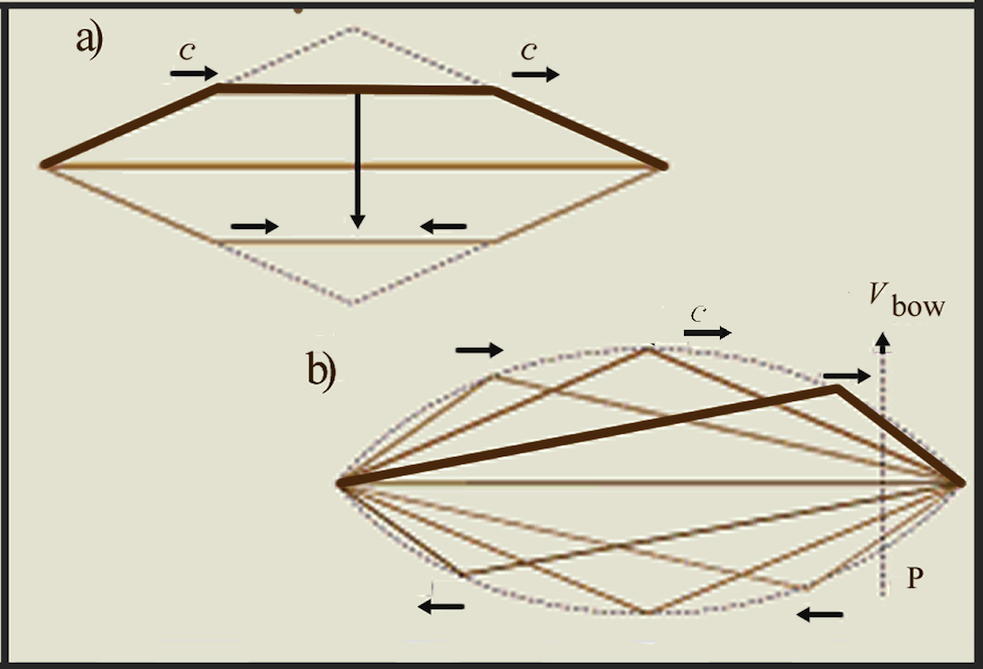 The outside dotted blue line in Rossing’s diagram shows us that there are two noticeably different envelopes formed when the string is plucked and bowed. The first (a) is the plucked string, which forms an envelope in the shape of a parallelogram, and the second (b) is the bowed string, which forms a parabola-like shaped envelope. [5] The bowed string is vibrating in Helmholtz motion; the critical aspect of behavior in a vibrating string, and is needed to produce the highest quality of tone from the instrument. [6] The plucked string is vibrating in a dysfunctional Helmholtz motion. Rossing’s description for why this happens is interesting. First, the small area of the pluck, second, the rigidity of the string, and third, “the loss of energy at the bridge perturbs the Helmholtz wave.” [7]
Many teachers use the ‘plucked string’ vibration as a model for their students to match when they ‘pull’ the sound from their strings with the bow. Could there be a way of teaching students how to bow in Helmholtz motion without using the plucked string as a model?
[1] Woodhouse, Jim and Paul Galluzzo. “Why Is the Violin So Hard to Play?” +Plus Magazine 31, no. 9 (September 2004). http://plus.maths.org/issue31/features/woodhouse/2pdf/index.html/op.pdf
[2] Ibid., introduction
[3] Envelope is the outer edge of the vibrational pattern that forms when a string vibrates
[4] http://www.learnersdictionary.com/search/parallelogram
[5] Rossing, Thomas D. “Springer Handbook of Acoustics”, (2007) Springer Science +Business Media, NY.
[6] Helmholtz, Hermann von. On the Sensation of Tone as a Physiological Basis for the Theory of Music. 4th. Translated by Alexander John Ellis. New York, New York: Longmans, Green, Doves, 1912.
[7] Rossing. “Springer Handbook of Acoustics,” (2007), pg 559.
Additional resources
Vibration:
Musical String Vibrations by Robert Johns. Johns discusses the differences in the plucked, struck, and bowed string vibrations, using a long lab spring on a gym floor to demonstrate the three different patterns.
The University of New Southern Wales – Animated Helmholtz Motion
Linear Systems Theory








Great Article. I really liked it. 🙂
This is so true! 😀
Wow very good amazing article 🙂
AWESOME! you must have done so much research! 🙂
Downloaded your dissertation – a must-read